Go to the final entry on this page .....Go to previous entry1 January - Best wishes for a happy, healthy & prosperous New Year. Looking back - On a dull and now wet day, with the temperature at nearly 11C this is the first time I have written in the diary for many months, so before attempting to kick start the 2012 diary into life I need to pass some comments about the 'lost time' between June last year and now. First, June saw the birth of our third grandchild, a little boy who has brought us smiles ever since. His arrival, along with time spent with his two gorgeous nieces has taken up more and more of our lives. However, despite the pleasure they bring it has been a frustrating time because my CFS has probably been at its worst since the beginning of the last decade, and with energy levels having to be watched and the children getting priority there has been little left over for garden management and its associated photography - at home, my macro lenses haven't seen the light of day for months, and last week was the first time I used a telephoto lens in the garden since last summer (more later). The summer weather was disappointing again, with lots of grey skies and cool temperatures, but dry, very dry. I have never had to top the ponds so often, a process that continued right through much of the Autumn. With the weather improving in September we made it to Cornwall and enjoyed ourselves doing a lot of relaxing in good weather. The flat sea conditions allowed for a bit of kayaking when the force was with me, and extremely low Spring tides allowed for some interesting walks on the sand that is rarely uncovered in Porthallow Cove. I did do a bit of photography during the holiday, but the very mixed results have got no further than a hard drive. Perhaps I will try to look through the images while winter continues. Talking of Winter, apart from a couple of a few flakes of snow that fell for just a short time on one day back in early December (or was it late November?) we have experienced no more that a handful of morning frosts. November saw the one of the lowest counts of air frosts in 50 years, and it was dry and mild (second warmest in over 100 years) but with lots of cloud cover. For much of December, daytime temperatures have been just above average, in contrast to December 2010 which was the coldest on record. We had some rain, but not enough to prevent 2011 being the second driest on record in parts of the south-east. Around Christmas the daytime temperatures reached over 10C after mild nights under an almost continuous blanket of thick cloud. Just to complement that greyness, Sheila and I have spent the whole Christmas period coughing and spluttering under an attack from a combination of virus and bacterial armies, and that battle is continuing as I write this! Finally, on a personal note, a serious health problem suffered by a member of our family means that through 2012 our priorities will continue to be away from the garden. While I hope to maintain the diary at some basic level, apart from recording important moments in the garden, I do not expect to be able to make more than occasional entries for the foreseeable future.
1 January - As mentioned above, a glum day with rain arriving in the afternoon. On Christmas Eve I refilled the tall peanut feeder beyond the big pond, and in the process tipped out the few remaining 'old' peanuts onto a pile of soil next to the Ivy tree. On Boxing Day we had our granddaughters and their mum and dad here for a while in the afternoon, and while I looked out into the garden with one of the girls I spotted an unfamiliar visitor at the bottom of the garden. We rushed upstairs for a better view and saw two Jays that had found the spilt peanuts.
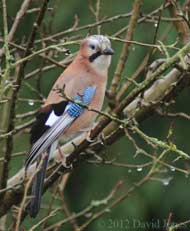
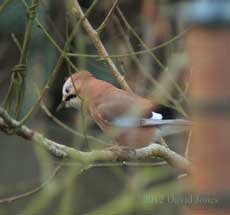
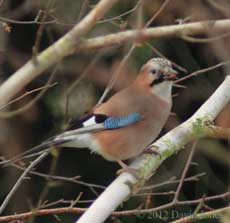
I dusted off the 'big' Nikon lens (300mm f2.8 + x1.4 converter) and set it up by the bedroom window. Since then I have scattered more peanuts each evening and the Jays have become daily visitors, always as a pair.
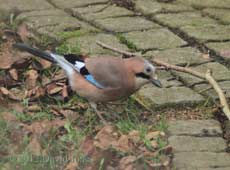
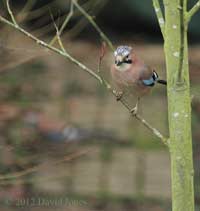
The gloomy conditions have required high ISO settings, and slow shutter speeds have resulted in numerous blurred photographs but occasionally one or other of the jays would perch in the open long enough to get off a couple of shots.
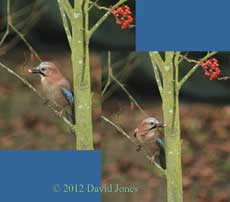
Here you can see one that had just collected a peanut - at other times they would eat one or two or take several to eat on the shed roof, hidden behind a bamboo plant. Usually I can see one or two in the beak when they leave. They have visited at least three times each day since Boxing Day.
In all those visits there was only one occasion when I saw a Jay venture down to the 'house- end' of the garden,
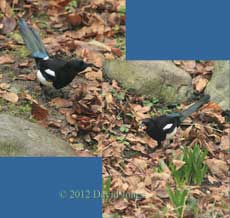
and on just two visits (that I've seen) they have been accompanied by a Magpie.
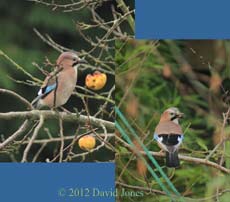
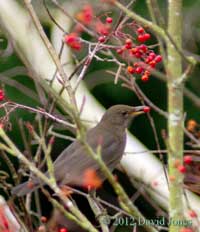
In the pictures above you can see a few of the Rowan berries. This winter for the first time there are many dozen berries waiting for winter visitors despite quite a few having dropped. I've collected some of these to put out near the house as and when we get any snow.
In the meantime, while I have yet to see a bird perch to eat the berries, I have seen a Blackbird male trying to grab one 'on the wing' and a Wood Pigeon trying to reach some from an apple tree branch before it turned its attention to the berries developing on the Ivy, the Wood Pigeons' favoured winter treat in the garden.
2 January - A blue sky morning, with the prospect of the sun staying with us all day. The lack of that cloud blanket has meant a temperature drop to below 5C, although there was no sign of a frost before the sun rose. It was a treat to see the blue sky, with the early sunshine lighting up the tree tops, and to top it all, the Jays were here and just at the moment I opened the curtains a fox trotted across in front of the Birch.
3 January - The first day since Boxing Day that I have not seen Jays in the garden, perhaps thanks to the weather!
Conditions remained miserable all morning, although the rain wasn't heavy, but widespread puddles on the roads indicated that it must have been heavier earlier on. Farnborough airfield recorded winds of just over 30mph during the morning, and at just before noon it was registering 35mph winds with gusts of 59mph. Then, within the next hour we had blue skies and the wind had dropped to less than 20mph with no gusts. That marked the end of the rain, although the wind picked up again just a little for a while in the afternoon. This evening the sky is clear.
23 January - Today has been mainly cloudy, with the temperature reaching 8C in the early afternoon. It was dry until mid-afternoon when it became gloomy, with darker clouds rolling in and spots of rain falling. In fact, since my last entry there has been very little in the way of rain, so that I have needed to top up the large pond to ensure a decent depth of water should temperatures drop below freezing. As it happens, so far this month the temperatures have remained comfortably above freezing, with just one 24 hour period when the ponds gained a thin coating of ice. I mentioned at the start of the year that Sheila and I were plagued by viruses over the Christmas period. Well, the bugs stayed with us for several weeks and today was the first time since before Christmas that I felt up to donning my work clothes and getting a bit of work done in the garden. That involved continuing with the pond clearing that I started several months ago. I have a bit more to do but at least it is now ready for the frogs to arrive. I saw just one today, disturbed as I pulled out some plants. The mild winter has meant that plants like the mint have been thriving.
The Jays continue to visit, although I only see them occasionally now, with my last sighting of them on the 20th.
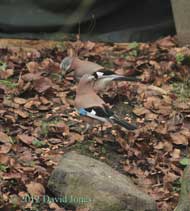
As usual, they arrived as a pair, although this was the nearest I could get to photographing them together, with one just a blurred patch of colours on the path beyond the Birch tree. And as is often the case they were being shadowed by a Magpie.
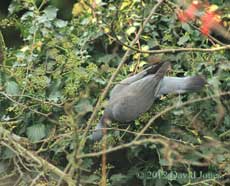
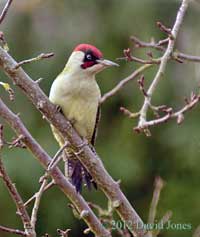
Not completely new to the garden, it is new to the diary as I can recall only ever seeing one here once prior to today, and that was many years before the diary was started. I have to confess that I can only just claim this as a visitor as it perched just briefly in our Birch before heading into our neighbour's Apple tree where it remained long enough to get a few photographs and for Sheila to come and see it.
Then it flew down to the grass in the neighbour's garden to hunt for its main food - ants. Frustratingly, I had to photograph it through the canopy of our Hawthorn, and at an oblique angle through our double glazed window, so this is a terrible picture, although at least it does show the green plumage of it back.
Getting back to the more familiar garden birds, at the moment we seem to have two Blackbird males in competition for feeding rights, and just one female. She has just discovered the Rowan berries!
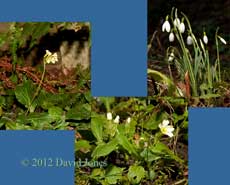
Now that I'm paying attention to the ponds again, I also need to get on with tidying up other parts of the garden as Spring flowering plants start to emerge.
Next to open was the first of our Snowdrops, on the 19th - most of the Snowdrops will not be ready to flower for another couple of weeks. Finally, the first Primrose opened on the 21st.
24 January - What a dismal day! It rained from before dawn until lunchtime, with the afternoon remaining heavily overcast with fine drizzle for much of the time, and a high of just under 10C.
While the wet conditions meant that the garden remained relatively quiet this morning, shortly before noon the appearance of a Magpie signaled another visit by the two Jays. As well as scattering a handful of peanuts this morning, in the absence of acorns I had also put out a couple of hazel nuts (left-overs from Christmas). When it left, one of the Jays clearly had one in its beak. Unfortunately I didn't get a photograph of that so I have just put out a few more ready for another attempt tomorrow.
25 January - Another grey day, but with no more than the occasional light drizzle today.
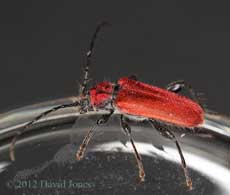
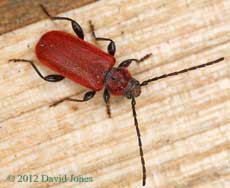
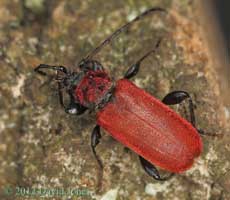
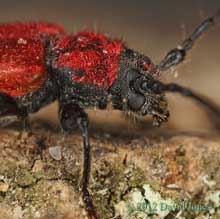
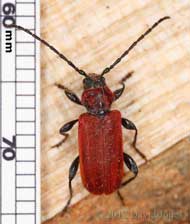
I believe that it is a Longhorn Beetle called Pyrrhidium sanguineum. This is a rather rare species in the UK although it is much more common in other parts of Europe. Its larvae develop in dead wood, including fallen timber, and this individual probably came into the house on or in a log destined for the log burner. Some logs are in the warm of the house for then best part of 24 hours before being burned so perhaps this adult emerged some time today.
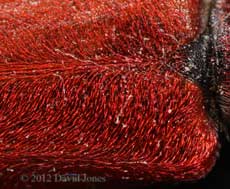
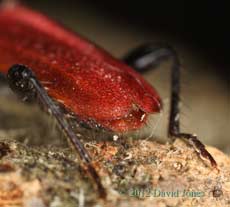
The red colour was particularly vivid, but when you looked closely it was clear that the coloration was due entirely to a covering of hairs. The actual surface of the elytra is black
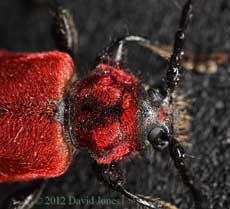
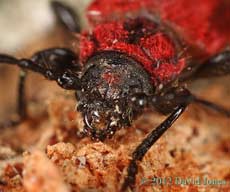
While the elytra (wing coverings) and the thorax have a complete covering of hairs, the head has just a small patch of red hairs along with areas of beige or ginger hairs.
Interesting - after I had taken these photographs (in a bit of a rush) I decided to put the beetle outside in a container so that I could take a bit more time over photographing it tomorrow. A short time later I checked on it, only to find it on its back with no sign of life. It clearly didn't like the colder conditions outside - the temperature was around 9C. However, when I brought the container back indoors the beetle became active once more within a couple of minutes. It's now on a piece of seasoned oak in a much larger container and will remain indoors overnight.
27 January - It has been a bit colder today. There was a high of 8C on a largely sunny day, spoilt by just a bit of rain as darkness fell at around 5pm. By 8pm the skies were clear and there was ice on car windscreens. It seems that we are now in for several weeks of cold weather. Over the last few days I've had little time to look out into the garden so I cannot report on any visits by either Woodpeckers or Jays, but the beetle is still alive and I have had the chance to take more photographs of it, this time on an oak log.
First, a dorsal view. As is often the case, a search of the internet comes up with mixed results, but I am now certain that is is Pyrrhidium sanguineum. With it being a rare species it is a pity that I cannot pinpoint where the timber came from, beyond saying that it was possibly from somewhere in north-east Hampshire!
Here it is in the middle of cleaning one of its antennae.
While the dorsal surface is dominated by the coat of crimson hairs, the rest of the body is largely black. However, there are exceptions. The rear end of the abdomen is also covered with red hairs,
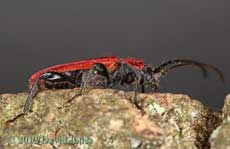
and in this side view you can see that around the insect's 'neck' there is ring of hairs
which are red and beige in colour. In these side views notice how some of the hairs at the front of the elytra and the thorax are erect rather than lying against the surface. Those areas appear to correspond to the regions that appear darker in the dorsal views. This image also shows how the compound eyes are wrapped around the rear of the insect's antennae.
Finally, for the moment, a front view of the head reveals a beige 'moustache'. I hope to spend more time photographing details of the beetle over the weekend. I also need to take a photograph that includes a scale.
28 January - After a bit of sunshine first thing the day turned overcast, and cold - 6C at 3.30pm. This weekend the RSPB's Big Garden Birdwatch takes place, with participants recording bird numbers in a garden or park etc over a period of an hour at any time over the weekend. It was a good excuse to sit and watch the garden just before lunch today (noon - 1pm). By the end of that hour my list included eleven species - House Sparrows - 12 Goldfinches - 7 Wood Pigeons - 3 Blackbirds - 3 Blue Tits - 3 Great Tits - 2 Robins - 2 Starlings - 2 Jays - 2 Dunnock - 1 Wren - 1 I guess that one problem with the leeway as to when you can carry out the survey means that the same garden can yield very different lists. In my case I have just watched again between 2.30pm - 3.30pm and this time the count was - House Sparrows - 7 Wood Pigeons - 4 Blue Tits - 2 Blackbird - 1 Robin - 1 Between the two periods the temperature remained just about constant but light levels had dropped appreciably.
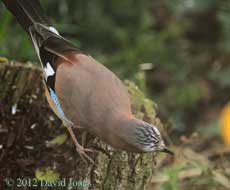
During the first count there were two Jay visits. Unusually, the first was by just a single bird which perched in the Birch tree, raised its head feathers into a small crest and called several times, each call being a single 'kaw' which was not particularly loud, and certainly not an alarm call. A Magpie that perched atop the conifers a little earlier was much louder. This is the first time that I've seen / heard this during a visit, and I assume that it was calling its partner. It then flew down to the ground below the tree before heading back towards the Brickfield nature reserve.
It wasn't long before both birds appeared to forage for the peanuts scattered below the tree.
29 January - A high temperature of just 4C under grey skies as the cold spell starts to take hold.
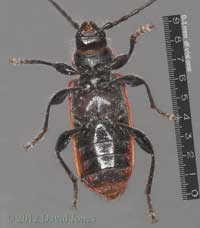
No bird pictures today (so I will be submitting the bird list recorded yesterday) but what should be the final Longhorn beetle images. First, a straightforward picture of the beetle next to a scale that shows its body to be just over 9mm in length. Its antennae are slightly shorter at 7mm.
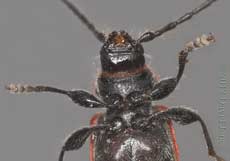
Then, to confirm just how much the red colouring extends under the beetle, a photograph of its underside. The white areas seen along the central axis of the body are reflections from the ringflash that I used.
In the image you can see clearly how the 'collar' of red and beige hairs extends right around the underside of the neck.
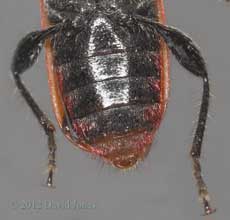
And finally, the rear end of the abdomen - In addition to the red hairs that can be seen either side of the segments to the rear of the hind legs, it appears that the epidermis of the final segments is also red.
30 January - Another dry day which was largely cloudy but dry, although there was a peppering of granular snow at some time between 7 - 8am. Despite that there was no sign of ice on the ponds this morning. The temperature only managed a 'high' of 3C during the day and at 9pm it is down to 0C in the garden. No photographs today, although there was the potential of an excellent photo opportunity this morning. I went outside to put some paper into our recycling bin and warning calls from a rook had me looking up to see it mobbing a Buzzard directly above our garden. Needless to say, both birds had disappeared by the time I put a suitable lens on my camera!
31 January - A bright, hazy morning, and cold - the high of 2C was reached in the mid-afternoon. For a while during the afternoon there was a great contrast between bright blue skies to the west and dark, threatening cloud to the east, and there were a few flurries of snow. That came to nothing and the skies were clear by dusk. At the beginning of the month I mentioned an illness in the family. Well, this afternoon there are smiles all round after some very encouraging news that has brought some very welcome optimism to everyone. Treatment is to continue, but that important member of our family should now be able to enjoy life so much more in 2012 - a great way to come to the end of January!
Click on images to see larger versions
|
|