Go to the last entry on this page .....Go to previous entry
7 August - Another decent day with a high around 22C.
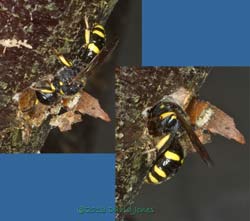
For most of the time I also listened to it. Click here to listen to just over a minute of activity (Be warned, the track is in mono, lasts just over a minute and has a file size of 953KB. You may need to turn up the volume!). At the start of the track the wasp can be heard biting at the wood. Then there is a period of (I assume) moving the debris before the biting restarts.
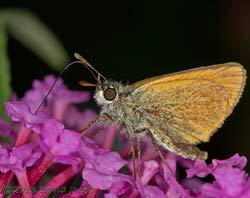
The Skipper was here again today. I think that it's probably a Large Skipper - I need to compare it with more photographs that have a positive ID attached to them.
8 August - The good weather continues, with a high of 22C for much of the day, with a bit of a breeze. Another good butterfly day with ten species counted.
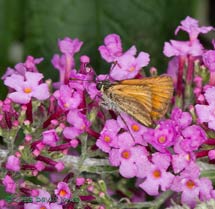
The Skipper appeared once more,
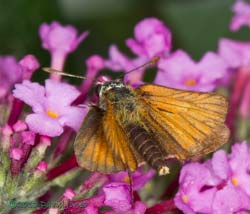
and this time it presented opened wings to the camera.
It shared the Buddleia with the usuals,
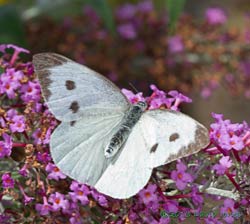
the Large (and Small) Whites,
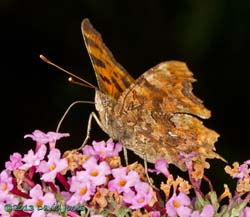
and a Comma, as well as several Peacock butterflies, a Small Tortoiseshell and a Brimstone.
Away from the Buddleia, three more species brought the day's total to ten.
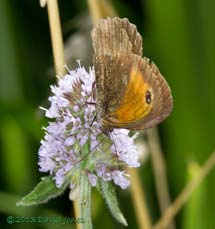
A gatekeeper was spotted feeding at the newly opened mint flowers in the big pond,
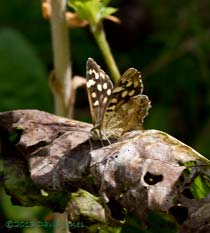
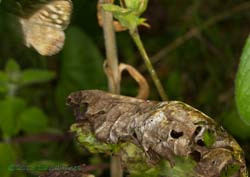
and tucked away in the dappled shade was this Speckled Wood. In this case the picture is a bit out of focus as I was having the lean a long way over some plants, and the flash wasn't charged!
Unfortunately, the Speckled Wood seems to be particularly sensitive to that first flash and its very quick reaction times mean that it is almost out of the frame by the time the picture is taken!
Anyway, the last of the day's Butterflies, a Holly Blue, appeared at the end of the afternoon and chose the Hawthorn foliage rather than any flowers to land on.
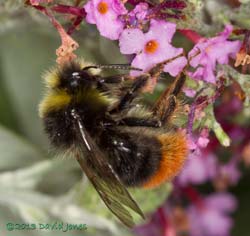
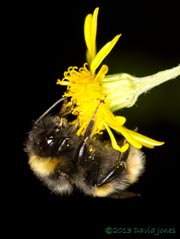
Returning to the Buddleia, along with the butterflies and other Bumblebees, a single example of a male Red-tailed Bumblebee (Bombus lapidarius) appeared today. I'm not sure that it was actually feeding. It also spent time on the ground in the sunshine.
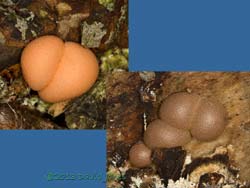
The decaying log (with solitary wasps' burrows in it) next to my workshop shed is 'sprouting' fungal fruiting bodies at the moment. The pair of bright orange ones seen here appeared today, which the lower picture shows another group that were a similar colour yesterday but which are now much darker. The largest of the bodies imeasures just over 1cm across.
The Buff-tailed caterpillars have vanished! I can no longer find any of them, despite placing my unturned umbrella in numerous spots under the tree, not one bit of frass has fallen into it. Judging by what I have read so far it is rather early for them having headed down to the ground prior to pupating. While that must be one possible explanation, it could also be that they are not eating while going through another moult. However, if that were the case I would still expect to be able find at least one or two. There is of course a third possibility - that they have been eaten, but by what? Which of our local birds would cope with a very hairy 6cm caterpillar?
10 August - A bright but partially cloudy day with a high of just 21C - still suitable for lunch outside when we visited our grand-daughters (+ parents of course).
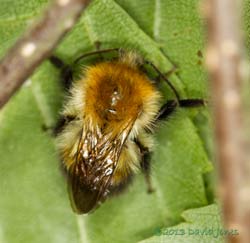
The lower daytime temperatures are having an effect. There were just a few large and Small Whites about today, and while saw a single Peacock butterfly during our lunchtime visit I saw none here all day. I saw several bumblebees grounded or at a complete halt on the foliage of the Buddleia during the day, and tonight at 9.45pm I found this Carder bee roosting under the shelter of Birch leaves - not a sight I expect to see when I do my rounds of the garden by torchlight.
During our time with the grand-daughters I did my usual garden safari, spending most time checking out their native Silver Birch tree. It was time well spent. The family has a hammock permanently set up on their deck and the girls love using it, and today I was able to show them a much smaller hammock made by the caterpillar of an Apple Leaf Miner (Lyonetia clerkella). While it is on the Birch, there is also an apple tree in the garden, and is something that I've seen on our Birch, but not this year so far. What made the discovery more interesting for the oldest of the girls was that we found what looked like an adult of that same species on another leaf. She also discovered a clutch of young caterpillars with some discarded skins, suggesting that they had just undergone their first moult.
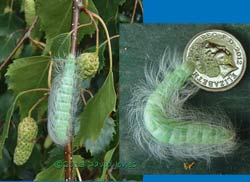
Then, as we looked at a colourful caterpillar of the Grey Dagger moth, we were both surprised by the appearance of probably the hairiest caterpillar I've ever seen! Dad (our son) provided his camera as I had forgotten to take mine, to get these photographs. On the basis of the 5p coin being 18mm across, I estimated that the caterpillar was about 44mm long (excluding hairs!).
Once home I was able identify it as a final instar caterpillar of a Miller Moth (Acronicta leporina). It is an interesting caterpillar in that it will burrow into rotten wood to pupate, remaining there over winter, not emerging until the summer. One guide says that it can remain as a pupa for two or three years. Talking of burrows, I've not paid any attention to the solitary wasps today, but last night I 'plugged' my microphone into both logs at around 9.45pm and could confirm that in both cases wasps were still actively burrowing. With the mint now in flower in the big pond a couple of regulars have reappeared to take advantage of them.
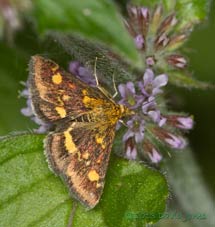
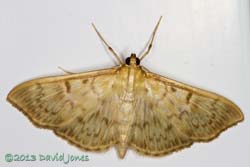
The first is the micro-moth Pyrausta purpuralis, a small but colourful species that lays its eggs on the mint.
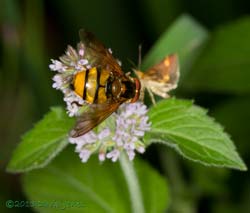
The second species that is enjoying the blue flowers is this large hoverfly which I believe is Volucella inanis. Sometimes there are two of them on the flowers at the same time.
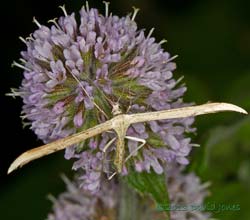
Of course, most of the moths appear after dark, and these days I'm usually too weary to stalk them. However, last night I recorded a few, starting with this Plume moth (Emmelina monodactyla) on the mint.
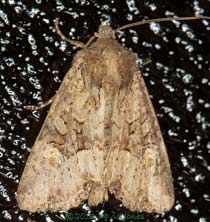
The next place to look was our kitchen door where moths are attracted by the light inside. This one I need to identify,
and the same goes for this, although I suspect that it is one of the Carpets. I need to match the wing patterns more carefully.
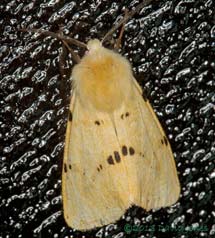
The third moth on the door was this Buff Ermine (Spilosoma luteum).
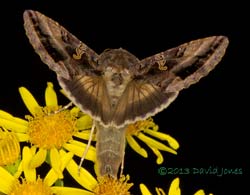
And finally, to the Ragwort for this Silver Y, caught as it vibrated its wings.
The fungal fruiting bodies recorded in the previous entry are all the same dull brown colour today, with no new ones having appeared.
11 August - Another bright and breezy day after a bit of rain that fell before I got up. The temperature struggled to reach 22C.
First of all, an addition to last night's sighting of the roosting bumblebee. At 10.15pm I found another one, this time a Garden Bumblebee hanging from a Ragwort flower. And it was still in place at 9.30am this morning - the Carder Bumblebee had gone by then.
The Large and Small Whites seemed to be the only butterflies about today, that is until two brightly coloured visitors turned up.
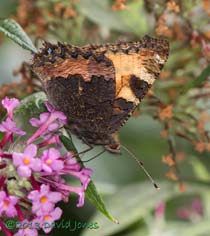
The first didn't look too bright when it first landed,
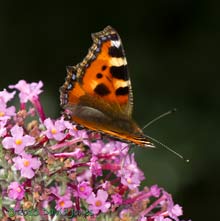
but then it opened its wings to reveal the vivid colours of a fresh Small Tortoiseshell butterfly.
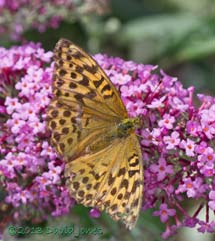
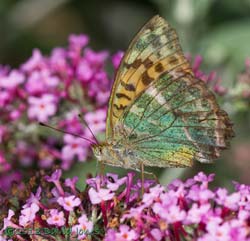
However, even that was second best to the next visitor - a Silver-washed Fritillary! This is the first time I have photographed one of these in our garden. The only other time that I've seen a Fritillary here was back in July 2003 and on that occasion I couldn't get close enough to be sure what species it was, let along take a photograph.
The pattern on the upper surfaces of the Silver-washed Fritillary's wings do not give a hint as to why it is so named - that secret is only revealed when the wings are raised above the body. This beauty brings the garden butterfly count up to fourteen species so far this year, and sixteen species since 2000!
I've finally taken the tall stepladder from under the Birch tree as there have been no further signs of the Buff Tip caterpillars. I can only assume that at least some of them are now down at ground level as they find a place to pupate.
Click on images to see larger versions
|
|