Go to the last entry on this page .....Go to previous entry1 August - After a couple of cool days, August is set to begin with a very warm one - and with a cloudless sky overhead it was already 23C at 9am.
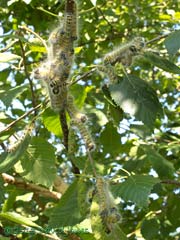
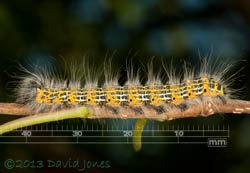
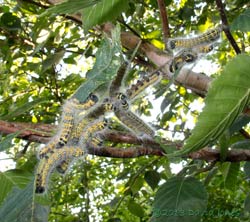
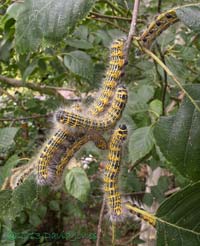
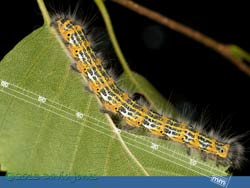
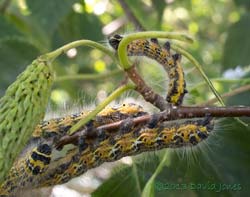
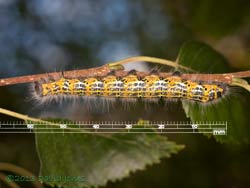
The Buff-tip caterpillars are becoming active once more as they embark on their fifth instar stage,
and this individual, conveniently away from the crowd gave me a chance to see how much larger they are now - about 41mm long in this case.
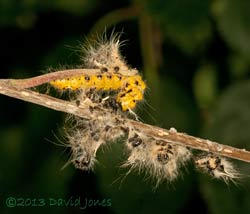
Moulting is a complex and difficult process, and this morning I see that there was at least one casualty during yesterday's mass moult.
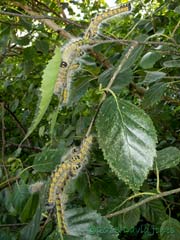
As the day progressed the caterpillars started to move away from this spot, and by the evening the army had split into two groups a couple of feet apart, although I'm not sure that this was by design or accident. I tend to favour the latter as the place they started from this morning was also a spot where branches crossed, touching for just some of the time as the breeze moved them.
At 6.30pm this smaller group of just twelve caterpillars was still very close to the place where they moulted. Even this group is somewhat fragmented.
The main group (position seen in the upper right background of that first photograph) is now on a completely different branch. I counted at least twenty two caterpillars in this group, making a total of (perhaps) 34 out of the original 59 that hatched out on 6/7 July.
The temperature rose above 30C by 2pm and in the shade of the Birch tree it achieved just over 32C soon after 4pm, not dropping back below 30C until after 6pm. And the sunshine helped turn the day into the 'Day of the Butterflies', with nine species making an appearance, the most I can recall ever seeing here on one day.
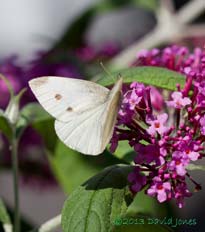
There were Large Whites,
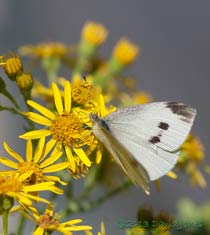
Small Whites,
Commas, Peacocks, a Red Admiral, a Speckled Wood, a Gatekeeper,
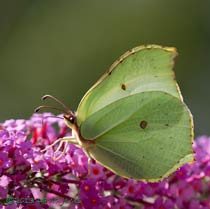
and this Brimstone (I'm annoyed with myself for not getting a sharper photograph!) - In the air they are inevitably bright yellow, by here, with the sun behind it the wings have taken on the appearance of pale green leaves.
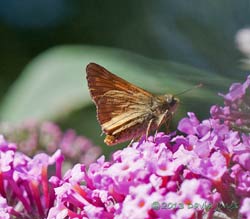
The ninth species is rather nearer being a micromoth than a butterfly - it is a Large Skipper, only the second time I've seen one of these in the garden.
If tomorrow's forecast is correct, there will be no repeat of today's conditions, with grey skies and temperatures some ten degrees lower - disappointing.
2 August - The forecast was only partially correct - the temperature was lower than yesterday's record high, but on a largely sunny day it still reached 25C during the afternoon. There was just the slightest touch of dampness in the air for a short time in the late morning, and again briefly earlier this evening. At 8.40pm the sky is largely clear.
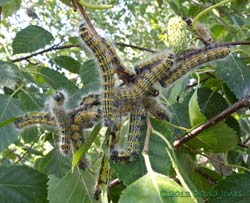
Today I have not been able to find all the Buff-tip caterpillars. While there are still a couple of groups close together I cannot account for at least a dozen. This is the smaller of the groups I have found,
and this is the larger cluster. When these pictures were taken this morning there were also a couple of pairs and trios of caterpillars on other branches nearby.
The only other caterpillar that I could find was this individual, near the end of a branch accessible from ground level and a couple of metres away from the rest. Like most of the others, it is over 5cm in length now, near to 5.8cm when stretching to feed.
However, In the main group I see that there is one caterpillar that is appreciably smaller than the rest. Has its moult been delayed for some reason?
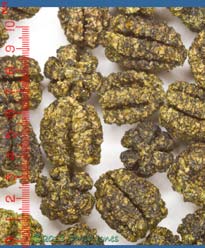
The main group happened to position itself directly above the platform at the top of the stepladder. This meant that as they fed some of their droppings (frass) landed on the platform, and I was able to collect them and take a close look. Measuring about 3.3mm in length, with a diameter of 2.6mm they are somewhat bullet shaped with a cross-section that resembles a flower-head with six petals. I'm afraid that the reason for the shape will have to keep me wondering until another time.
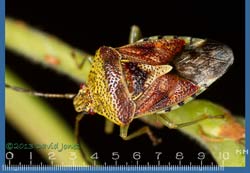
Going up the ladder and brushing against the foliage led to me unwittingly collecting (in my hair!) this example of a Parent Shieldbug (rather than a Birch Shieldbug, which I at first thought it was). It is barely 9mm long.
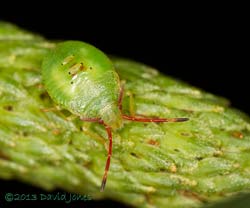
Just after I returned it to the tree I spotted this nymph that was feeding on one of the tree's developing seed heads. I think that this is a late instar (4th of 5th?) Green Shieldbug nymph.
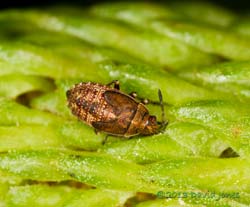
The seedheads are also the place to find much smaller nymphs like this one feeding. This is not a Shieldbug, but I suspect one of the leaf bugs, or a seed bug. I shall have to keep an eye on these.
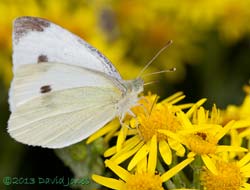
It has been a quieter day for butterflies. Having said that, there has still been Large and Small Whites (one seen here),
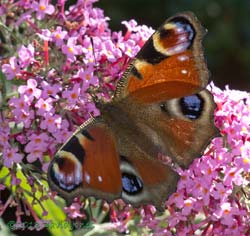
Commas and a couple of Peacocks feeding here.
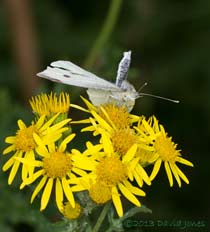
There was also courtship going on, especially between Small Whites, and for a while we had a pair of Meadow Browns (not seen yesterday) chasing each other between flower heads. In this picture a Small White female has raised her abdomen in response to a male which unfortunately flew out of view as I pressed the camera shutter button!
I have a great deal of catching up to do in order to catch up with adding the large images, but it may not happen until sometime in the next week as we are going to have our grandson with us from tomorrow morning through until next Wednesday and so free time will be rather restricted !!!
3 August - A dry, largely bright day but a bit cooler, with a high of 23C. It is now becoming difficult to monitor the Buff-tip caterpillars as they spread out and get higher in the Birch canopy. This morning I could see no more than twelve at one stage and I resorted to using an upturned umbrella in an effort to find more. It worked, and the sound of frass falling onto the stretched fabric helped me to locate one group that had moved well out of reach of my step ladder. That is 2.4m high and they were at least another two metres above that.
There was one group of five that I could still access from the top of the ladder, and this caterpillar measured about 5.8cm. Later I had the chance to measure (but not photograph) two that were well over 6cm in length.
4 August - Another dry, breezy day with a high of 23C - very pleasant! There have been nothing significant to record about the caterpillars today, other than they continue to spread slowly across the tree canopy, mostly out of my reach now.
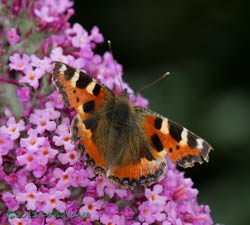
Today we had another butterfly to add to this year's list - a well worn Small Tortoiseshell which spent quite a bit of time on the Buddleia.
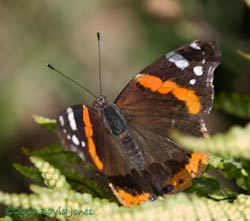
On the 1st I mentioned seeing a Red Admiral. It (or at least another in the same tatty condition) was here again today and this time I did manage one less than sharp photograph to record its visit.
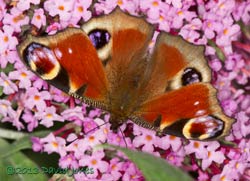
It was particularly dull when compared with the brightness of the two Peacock butterflies that spent much of the day here. This one remained in position long enough for me to lift up my grandson to take a close look - his response was a prolonged 'Waaaw' as he watched it feeding!
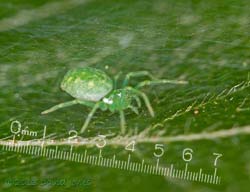
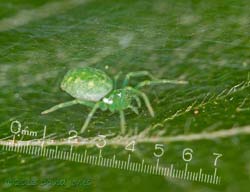
Yesterday I spotted something else that could be described at also brightly coloured, although with a very restricted palette, and very small. It was still in the same position this afternoon. On the upper surface of a Birch leaf this small spider stands out form the background thanks to its almost emerald green colouring.
It is ensconced under a canopy of extremely fine silk and is about 2.5mm long.
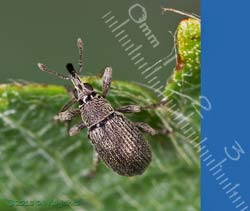
Another small inhabitant of the Birch is this weevil species. A long time resident (photographed previously in Sept 2006) I have yet to identify it, but it does not match the description of the weevil responsible for the examples of leaf rolling that I reported on for the first time on 5 July. They were most likely produced by the Birch Leaf Roller (Deporaus betulae).
Something that I've been meaning to comment on this last week is the total absence of ladybirds so far this summer, both adult and larval stages - not even Harlequins are appearing. I understand that last year's bad summer may be responsible for their absence. And another disappearance has me flummoxed today. Our House Sparrows are normally a daily source of entertainment form dawn to dusk, but today I saw just one solitary male come to the feeder. Where have they gone? I have to hope that this is just a temporary absence and that things will return to normal very soon indeed!
5 August - A cool day with a high of 22C briefly during the morning before we had some heavy rain during the afternoon when the temperature dropped below 20C, and was down to 16C by 5pm.
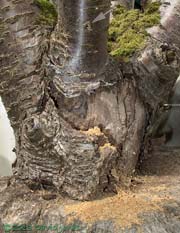
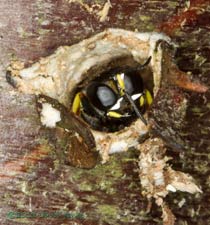
Our grandson occupied us for most of the day, and it was only while he slept in the middle of the day that I had the chance to head out into the garden with my camera. I took that time to set up the camera to monitor a solitary wasp's burrow for about an hour. The wasp has burrowed into the side of this stump from an apple tree. You can see the pile of sawdust below the log and the hole indicated near the top of the image.
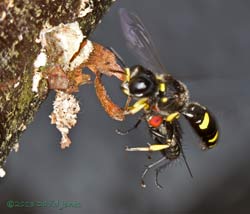
The hour was really far too short a time for this task. The wasp arrived while I was setting up my tripod, then left and returned just once more before the threat of rain had me heading back indoors. Here it is about to leave the burrow, the opening of which is about 6mm across.
One problem with capturing a moment like this is predicting accurately the approach path, so that the wasp is going to be in focus. I got close but not quite there with this one attempt, but at least it shows that the prey in this case was an adult fly with bright red eyes. In two days time I should be able to dedicate more time to this wasp, assuming that it is still stocking the burrow.
6 August - A dry, largely sunny day with a high of 22C, and no breeze - disappointing as we had hoped to fly a kite today! I took advantage of our grandson's midday sleep to once more target the solitary wasp for an hour and a quarter. This time, to help me decide if the was was 'at home' I wired the log for sound by inserting a small microphone into a hole in the timber. This worked well, apart from the fact that new neighbours a few houses away were working rather noisily in their back garden, and another neighbour on the other side of us was using his hedge trimmer so the recording wasn't going to be quite up to BBC standards!!
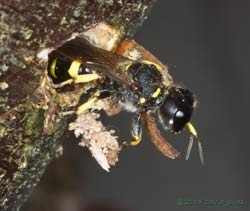
Anyway, the wasp was in residence when I started and didn't leave until I had been watching for about fifty minutes, which is when I took this picture - there was no time for a second shot and I was perhaps a little too soon pressing the shutter. When it was time to pack up there was still no sign of it returning.
At the end of the afternoon I checked on the caterpillars - and could find just one! And that was way out of reach. Even the individual that had remained accessible from the ground up until yesterday had disappeared. I resorted to a pair of binoculars to scour the upper branches, and so far not even the upturned umbrella has helped. That has been left in place tonight to be checked again in the morning. The House Sparrows remain quiet, but at least there were up to six feeding here today. I didn't see any activity around the nest boxes so those birds may well have been visitors to the garden rather than residents.
Click on images to see larger versions
|
|