Go to the last entry on this page .....Go to previous entry
25 July - A pleasant day with a high of 24C. There had been a touch of dampness early in the morning, before I headed downstairs at around 7.45am.
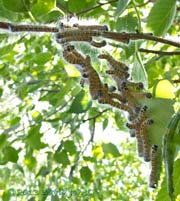
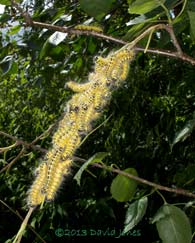
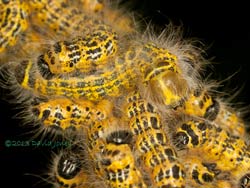
Now that their third moult is over and done with the Buff-tip caterpillars are on the move again.
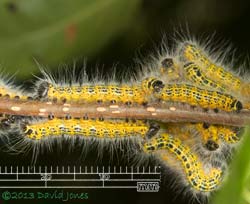
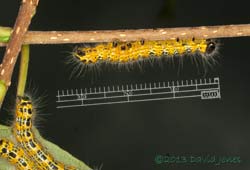
They are now noticeably larger, measuring around 25mm in length,
so it's not a surprise that the army is starting to break up into smaller groupings. Tonight at 8.30pm they are spread up over four leaves. The couple of individuals that are wandering between groups does suggest that they may not have finished sorting themselves out for the night so it will be interesting to take another look after dark.
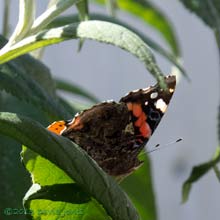
A couple more butterflies to record today. First, this Red Admiral, possibly attracted by the Buddleia flowers that are now in bloom. It wasn't possible to get any closer than this. However, the other butterfly was a Comma which was impossible approach at all. And there were several Large Whites here too, but again there was no chance to photograph them.
27 July - Sunshine this morning and for some of the afternoon lead to a high of 27C before clouds started to roll in from the south, as per the weather forecast. However, apart from a few occasional drips, at 7pm we are still waiting for the promised heavy rain to arrive. A little more patience was required - it arrived around 7.30pm, the first thunder roll coming half an hour later!
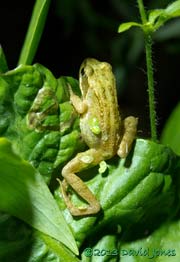
It is a pity that the UK does not have any tree frogs, so it's a pleasant surprise when you spot one of our native common frogs doing a bit of climbing. In all fairness, this one was only a foot or so above the ground when I took these photographs after 100m last night. This is an exploit reserved for the younger, more agile individuals. I occasionally see newts in similar situations, although newts have not been obvious in the garden so far this summer.
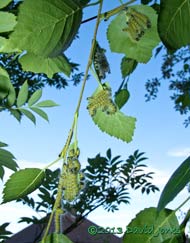
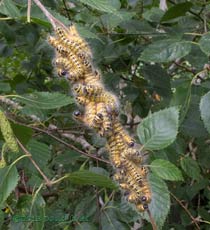
This picture, taken just before I spotted the frog, shows how the caterpillar army continued to come together at night, although this time spread of two adjacent leaves as their increasing size limits how well they can group together on the Birch leaves. There were more caterpillars on the reverse side of the leaves. How will they cope with heavy rain?
By lunchtime today they had eaten their way through several leaves and were on the move again.
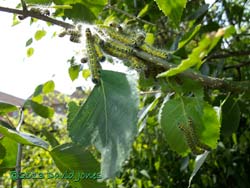
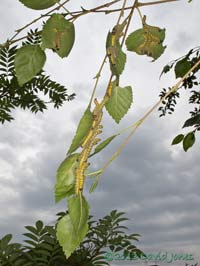
At 6pm I photographed them again as the cloud cover started to become more threatening. This time I couldn't decide whether or not they were resting having just arrived at a fresh set of leaves. Anyway they are clearly continuing on their journey upwards and the highest are now about of 11ft above the ground.
They have also grown appreciably since the last moult. This individual is just over 30mm long. Unfortunately it wasn't possible to count how many caterpillars make up the group now.
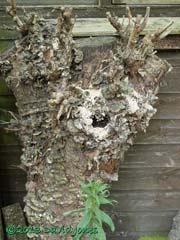
Having largely ignored the solitary bees and wasps so far this summer I spent a while this afternoon sitting on a stool watching this old tree stump which as spent several years decaying in front of my workshop shed. The light coloured areas are actually pile of sawdust discarded by at least two small solitary wasps, and I believe that a third one is at work around the back of the log. My aim was to photograph any wasp that approached the log.
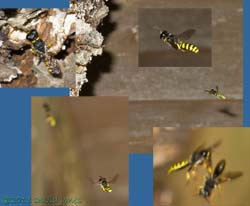
Well, there certainly was a great deal of activity. However, the wasps very rarely landed where I could see them and their darting flight near the log made it extremely difficult to get useable shots that were anywhere near being in focus.
This group of pictures sums up what was achieved, including two images that include two wasps. The bottom-right image, hopelessly out of focus, is interesting in that it shows an interaction between the two where one appears to be inverted -oh for it have been clear.... Trying to identify the species is going to be difficult based on these pictures, beyond saying that they are digger wasps and match quite closely pictures in my guides of members of the Family Sphecidae, possibly a species of the Genus Ectemnius.
I must have some more attempts to get better images of these wasp, if possible bringing prey as feed for their offspring.
28 July - Just a quick note about the Buff-tip caterpillars this evening.
While some are still eating it is clear that they are coming together as a cluster once more.
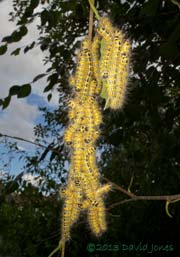
29 July -A fresher, breezy day with a high of just 22C and which stayed dry right into the evening when we had some rain associated with a thunderstorm that passed to the north of us. The weather was good enough for us to spend quite a bit of time outside with our grandson, and that time was rewarded with some real 'wow' moments - One of the first came when he climbed my tall step ladder (with me very close behind him) to say 'hello' to the caterpillar army and he was surprised by their size.
They stayed put in this spot all day, apart from the occasional individual that ventured away from the group briefly, and they are still there at 10.30pm. It's only four days since their last moult so I don't expect another to occur quite yet.
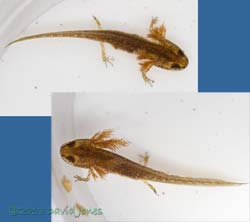
I have not caught sight of any newts in the garden for months now so it was encouraging to see that there are offspring present in the pond.
The next 'Wow' moment came when we checked for frogs - there were none to be seen. However, as a next best option I used a small container to scoop out a couple of tadpoles for him to look at. A tadpole swimming at speed around a circular tub definitely impresses this two year old, but for me the prize catch was this newtlet.
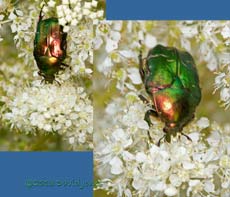
The third 'Wow' came when I picked up the little boy to take a look at this Rose Chafer feeding on the Meadowsweet plant that dominates the far end of the big pond. A species that is a regular summer visitor to the garden certainly likes this plant with its masses of small white flowers. These also act as a magnet for Honey Bees and Bumblebees, including Tree Bumblebees. This species has made an appearance here at least twice over the last week.
The breezy conditions made for difficult picture taken when the garden was visited by butterflies today. There were large and green-veined Whites seen, but not photographed,
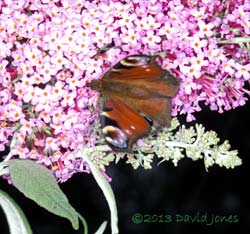
This Peacock which I saw just once this morning (not a sharp image),
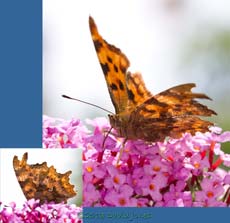
and this Comma which was in the garden several times during the day. The small, rather out of focus image shows the small white mark that gives the species its name.
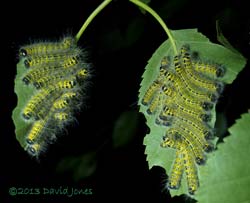
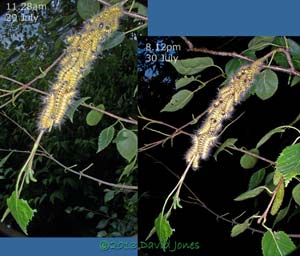
30 July - Cooler again today with a high of just 20C thanks to some broken sunshine in the late afternoon after a dull, drizzly morning. We were otherwise occupied today (guess who!) so the only photograph for today's entry is of the caterpillars.
It was taken this evening, and I have included a photograph of them taken yesterday morning to show that they have barely moved at all during the last thirty three hours. Not even the leaves just below the group have been touched during that time.
This suggests that they are about to moult once more, and a closer look at the heads of some of the caterpillars reinforces this. The black head capsule now looks far too small compared with the bulbous area immediately behind it, with a transparent area that suggests to me that the process is underway.
31 July - The final day of the month has started grey but dry, with no sign of the rain that we expected.
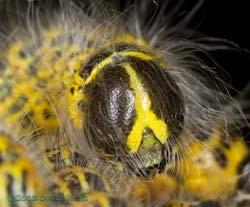
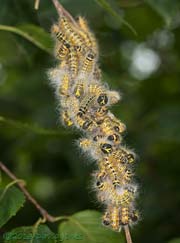
The army of Buff-tail caterpillars is ending the month with its fourth moulting session. Here was the cluster as seen from the other side for the first time at 9.40am at which time I could see just one caterpillar that had already undergone the transition,
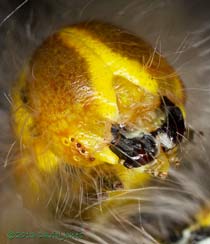
its bulbous yellow head standing out from the crowd.
By 10am it had already darkened appreciably, apart from the inverted 'Y' which remains bright yellow. At the bottom-right of the head you may just make out one of its set of simple eyes.
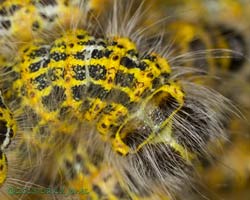
This shows the back of this same caterpillar just behind the head.
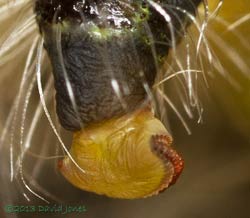
The position of the caterpillar gave me a chance to take a look at its rear end which was being held aloft.
I can't help by compare the claspers with a pair of leather mitts with red velcro trim!
By 2.30pm more than half the caterpillars had undergone a moult. Four hours later I could still see a couple that had not yet completed the process, and just after 10pm I see that no caterpillars have so far left the cluster, but I didn't take a close look to check if any had still to moult.
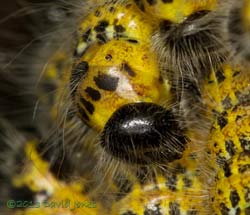
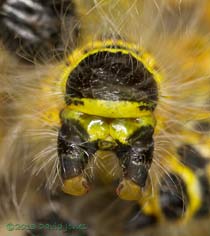
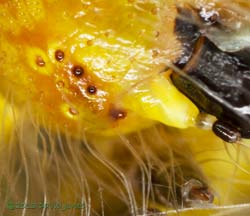
Earlier, I mention the caterpillar's eyes. Caterpillars have six pairs of simple and for the first time I was able to see all six eyes on one side of the head, along with some of the other structures around the mouth.
A first glance it may look as though there is a group of seven eyes rather than six, but looking closing it is possible to see that the smallest, (second down on the left) marks a spot where one of the caterpillar's many sensory hairs protrudes through the exoskeleton. To the right of the cluster is one of a pair of rather stubby antennae, positioned either side of the large (and already hardened) mandibles.
Click on images to see larger versions
|
|