Go to the last entry on this page .....Go to previous entry
15 June - Is it a month since I last added anything to this diary? That wasn't meant to happen. Anyway, I hope to do some catching up over the next few days, but in the meantime - The diary stopped on 15 May because we were about to pack our car and head off (on the 17th)to our usual hiding place in Cornwall for a couple of weeks, returning home on 2 June. Since then time has flown while we have been involved with our grandchildren and what time we've had to ourselves has been taken up with all sorts of chores! As soon as I can I hope to add a short page about Cornwall, but my first task is to catch up with the garden.
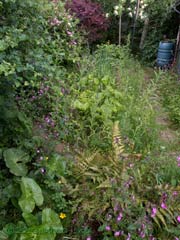
Anyway, back to the garden. When we returned we were greeted with the usual sight that would cause heartache for many a gardener, but for us it was a reminder of the Cornish hedgerows and verges that we had just returned from. The only task that required my attention with any sort of urgency was the clearing of a couple of bits of the garden path.
With Spring being late both in Cornwall as well as here it was interesting to look for comparisons.
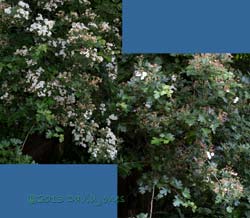
I didn't take any pictures at the time but this pair of images show part of the tree on the 10th and 14th as the flowering period was coming to its end. Today there are just a few flowers to be seen in that same area.
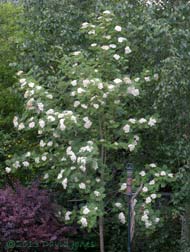
On our return I noticed that high up on the Rowan a single inflorescence appeared to have come into bloom. By the end of the week most of the flowers on that tree were open. By yesterday the original group of flowers was looking decidedly off-white. After the tree failed to produce any berries in 2012 I have my fingers crossed that enough insects have visited the tree this time to give better results. For much of the time since the tree came into bloom the weather has not been great, and when I have stood and watched there has been Bumble Bees and Hoverflies visiting but not in great numbers.
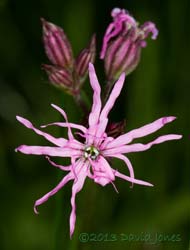
As usual the Red Campions rather dominate the garden at this time of year, so it is good to see other plants also doing well, such as the Ragged Robins which prefer the damp conditions at the side of the pond.
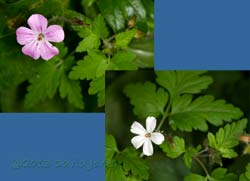
The other red flower that pops up in all corners of the garden is the Herb Robert. And it seems that we have a 'new' addition this year in the form of a white variant that has appeared next to a 'normal' pink flowered plant under the Hawthorn. It has slightly narrower petals than the pink form. It will be interesting to see if this plant produces viable seeds and reappears in 2014.
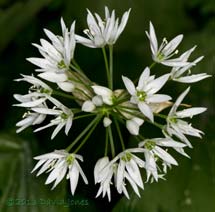
The other white flowers that greeted us on our return were the Wild Garlic (Ramson). Having started to bloom before our holiday these were coming to the end of their flowering season and are now well into their seed production phase.
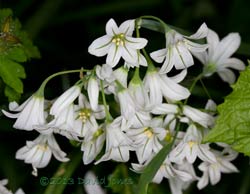
The Triangular stemmed Garlic, Not ready to flower on our departure, was in full bloom on our return, as they were in Cornwall before we left there. Unlike the Ramsons, as time goes on and their flowering comes to an end their lush foliage 'falls over' to form a mat over the ground. Most of ours are now in this state.
No photograph this time but another white flower in evidence is that of the White Dead Nettle. With that and the Stinging Nettle in flower at the same time there was the chance to show my eldest grand-daughter a couple of differences between the two plants.
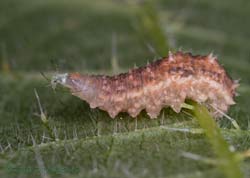
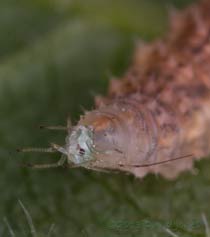
I needed to remove one Stinging Nettle plant from a spot near to our veranda, and under a leaf I found this lacewing larva which was tucking in to its favourite food - an aphid.
I was too late to get any good shots of it, but I did manage to get this 'portrait' which shows its tiny red eyes, something that I hadn't noticed previously.
Turning to yellow flowers now, and first the Dandelions - not one to be seen at the moment in marked contrast to the month before our holiday when they were popping up everywhere.
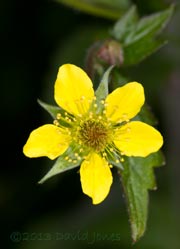
One of my favourites, the Wood Avens is in flower now, along with Field Buttercups and a couple others which I will leave to the next entry.
The larger flowers of the Marsh Marigolds are now coming to an end and this even I can see just one left with a full complement of well worn petals.
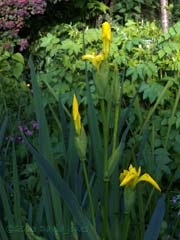
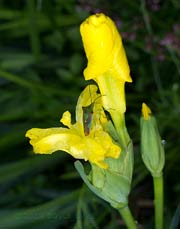
However, the pride of the yellow flowers only started to bloom two days ago - the Flag Irises. Last year I cut back the rhizomes of these plants quite drastically so I don't expect many flowers this year.
I took that picture yesterday morning as the sun came up over the rooftops, and that moment provided a bonus in the form of this Hawthorn Shieldbug that had chosen a good spot to soak up some early sunshine.
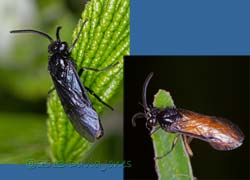
One important reason for looking after the Irises is that provide a 'home' for the larvae of this species of Sawfly (Rhadinocerea micans) which is entirely dependent on the leaves of the Flag Iris as its food source. There are adults about at the moment, and although I have yet to see any of their larvae there are signs of their feeding activities on the leaves of the plants.
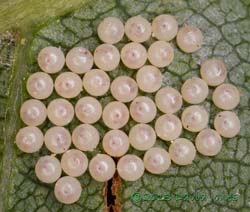
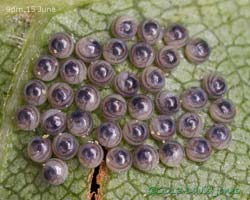
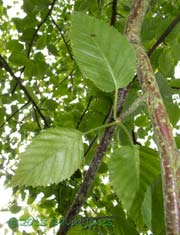
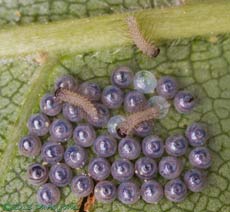
The day before yesterday I trimmed the tips of a couple of branches of the Birch tree that were getting tangled up with those of the Rowan (planted a bit too close to the Birch, and too big to move!). On one of those trimmings I spotted this cluster of insect eggs. I stood the branch into a jar of water, and took this photograph (although not until around 5pm yesterday).
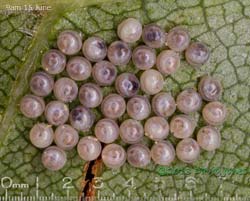
This morning at 9am I took this second photograph showing changes that indicated clearly that all 39 eggs are fertile. Each egg measures about 0.8mm across.
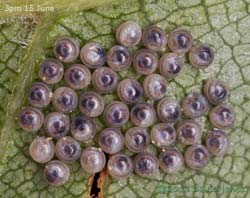
By 3pm the eggs had changed quite dramatically,
with the marking becoming more pronounced by the time I took this photograph at just after 9pm. At the moment I have no idea what the insect species could be, other than these eggs are not right for a shieldbug!
Finally, a mystery over another insect on the Birch tree. This time it's a larva that puzzles me.
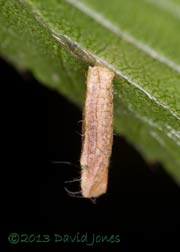
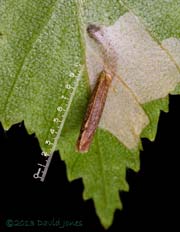
Yesterday afternoon, this caught my eye as a small structure hanging from under a leaf. A close look at the photograph suggested that the structure was a rolled piece of leaf,
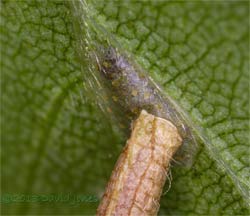
and where it was attached to the leaf there was clearly some damage, and something was within the tissues of the leaf.
This was confirmed when I looked at the upper surface and saw what appeared to be the head end of a larva underneath the epidermis of the leaf.
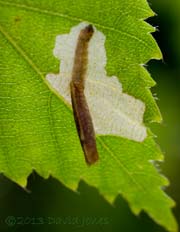
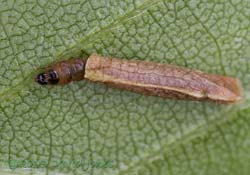
This morning things became much clearer when at around 9am I checked the leaf in the morning sunshine. The folded leaf is the 'home' for a larva that is feeding on the internal tissues of the leaf.
When I checked it during the afternoon the larva had withdrawn into its case, only to resume feeding in early evening. This photograph was taken just after 6pm. I could still see it at around 9pm.
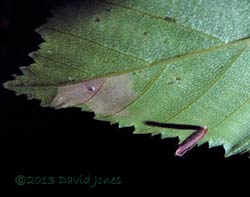
When I looked again at 10.30pm I was surprised to see that the larva had moved to another part of the leaf. You can see the opening through which it had entered the leaf to feed during the day. It will be interesting to see what happens tomorrow - will it continue to feed on this leaf or move on to a new one? I need to check the rest of the branch for damage that it had already caused before I spotted it.
I have an initial question about this larva - is it classed as a leaf miner? I thought that in those types the larva remained within the leaf for much of the time as they developed, and usually their 'mines' become contaminated with frass (their droppings). In this case the cavity in the leaf has been left clear of such deposits.
16 June - On what is a grey morning I'm quite literally on the trail of the mystery larva.
When I first came downstairs at around 7.20am, my first task, as usual was to make a cup of tea. As soon as that was done I headed down to the Birch tree and checked the leaf. Sure enough the larva was still suspended under it. However, although it had clearly been feeding during the night, it was on the move once more.
By the time I returned to the tree at 7.50am it had left the leaf and was several centimetres further up the branch, having passed the next couple of leaves.
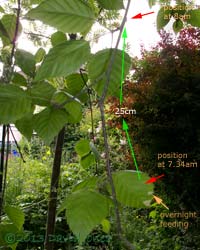
At 8am it had reached a position about 25cm above where I first photographed it at 7.34am. You may just make it out in this picture. This would suggest a rate of climb around 1cm/minute - pretty good for a small creature that has very short legs and which hardly emerges from its 'house' as it climbs! By 8.40am it had climbed at least another 45cm to where two branches touch. It moved across to this other branch and at 9am it has moved down to a point where there are three leaves - perhaps it is time to feed again.
At 9.15am it was half way along a leaf stalk and heading towards the blade of the leaf. However, when I next had a chance to check on it at 10.30am, that leaf was empty and undamaged, and the larva was some 50cm further up the branch and continuing to move upwards. The next time I try to photograph it I'll need a stepladder!
It's now 2.30pm and the wanderer has come to a stop under a leaf 2.6m above the ground. It hasn't fed since leaving the leaf (1.1m above the ground) that I first spotted it under, so I suspect that it will start feeding before the end of the afternoon. I'm just about to put a taller stepladder in place ready to take some close-ups once it starts feeding, if the rain stays away.
It is still enclosed in the original leaf tube at this point (close-up pictures will confirm this later). This leaves me with another question to answer - Will this tube suffice as it is for the fully developed larva, or expand enough to cope with a growing larva, or will the larva need to create a larger refuge for itself?
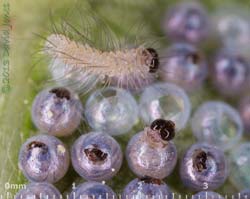
Turning my attention away from the larva for a few moments, at 3pm I noticed that three of the eggs that I'd been watching have hatched out into hairy caterpillars.
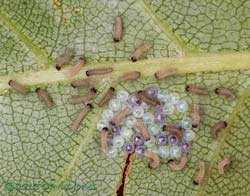
Over the next couple of hours just two more caterpillars emerged, but by 6.30pm it was clear that many more were hatching. While the eggs had a diameter of 0.8mm, the emergent caterpillars were close to 1.8mm in length.
By 9pm twenty six caterpillars had hatched, with the remaining thirteen eggs looking as though they should follow suite by the morning. If it is fine in the morning I intend to tie the twig to a similar sized branch of the tree so that the caterpillars have a chance to 'escape' back to the living tree where I hope to follow their progress in the weeks to come.
Just before I photographed the caterpillars I made one more check on the larva - and it had moved again. Having rested but not fed for several hours under the leaf shown above it has now moved a further 50cm along the same branch and is once again attached to a leaf. I have to wonder what the chances are that I will be able to find it again in the morning.
Click on images to see larger versions
|
|
2013 Garden Diary Index.... ....................... . ..June (part 2) |