Go to the last entry on this page .....Go to previous entry
17 June - On a grey morning the trek resumes!
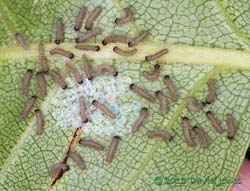
But first - On the veranda, the rest of the caterpillars hatched overnight, the picture showing all thirty nine still clustered around the egg cases at just after 7.30am.
I've now clipped the leaf that they are on back to the tree itself before they start spreading out, using miniature clothes pegs (originally used to hang up Christmas cards!).
Up in the Birch the larva spent the night in place on the leaf that it settled under yesterday evening. It had spent some time feeding but when I checked it at 7.30am it had withdrawn into its refuge.
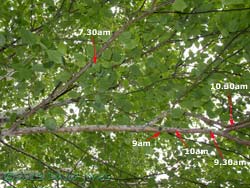
However, it was soon on the move once again, back on the branch, and heading towards the trunk of the tree. Over the next three hours it moved down that branch, only to turn at a fork and head back out along another one. During those three hours it must have covered over 1.6 metres, a distance which included it doubling back on itself between 9 and 10am.
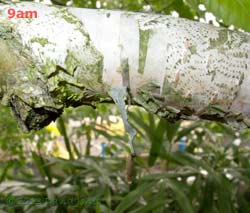
At 9am it spent a short time in a really precarious spot, hanging form a fragment of the paper-thin bark, being blown about by the breeze.
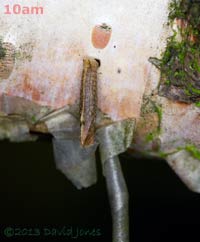
At 10am it was in the middle of a loop after it had doubled back some 15cm,
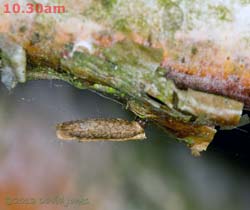
and at 10.30pm it had passed another fork in the branch and come to a temporary halt. This time it appeared to be feeding, presumably on the algae that grow on the bark.
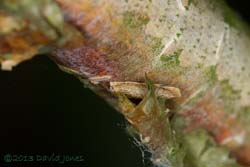
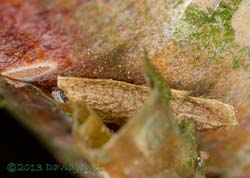
By mid-day it had moved just a couple of centimetres further on, and this time it tucked itself in between some curled up bark and the branch.
I can't make out whether or not the white 'mask' in front of its face was something that happened to be there, or was produced by the larva. It was still in this position at 7.30pm.
Earlier this evening I had my first ever definite sighting of a Tree Bumblebee (Bombus hypnorum) in the garden, with its characteristic brown thorax and black abdomen tipped with white. Unfortunately I didn't have my camera with me at that moment.
18 June - A mild (18C at 11am), cloudy morning that is getting a bit brighter as we approach mid-day. And a few minutes before noon I've just checked on the larva and it is still in exactly the same position as shown above, which leads me to consider if it has started to pupate. I shall try to get a close-up of it soon, although I'm not sure how much more detail I can get without disturbing it. Curiously, when I checked on the caterpillars this morning I could see just one, and that too has disappeared now! There's nothing to suggest bird activity around the leaf.
On the other side of the tree, one branch bears two points of interest. First, these adjacent leaves, cut and then twisted in a spiral to form pendulous protective cases - for pupating insects?
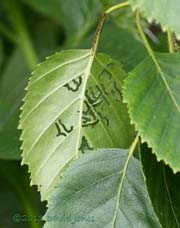
And just below, another leaf is being sculpted (sorry, eaten) by a group of very small sawfly larvae - their efforts resembling a young child's first attempts at writing!
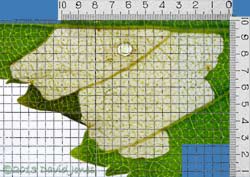
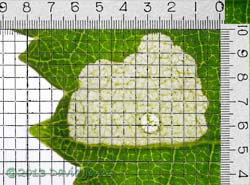
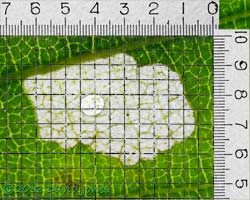
To satisfy my curiosity, this evening I decided to try and work out roughly how much the larva ate when it mined the leaves during its travels. First of all, I photographed each area of damage leaf at x2 scale. Then I photographed a grid of 0.25mm squares at the same scale and overlaid this image over that of each leaf. Counting the squares (and half squares etc) gave me an approximate area that had been eaten on each leaf. Using a micrometer designed for soft materials I then measured the thickness of the area between veins on leaves that were similar in size to those that were fed on. These had an average thickness of around 0.15mm. Next, I cut out the portions of epidermis left after feeding. I repeated this several times and found that measured together the upper and lower epidermal layers measured about 0.05mm This means that the space between these layers, occupied by the endodermis (and eaten by the larva) must have had a thickness of about 0.1mm.
The first, and largest feeding area visited during the time that I was observing it measured some 62mm2, and the thickness of 0.1mm means that a volume of about 6.2mm3 of tissue was eaten on 15 June.
On the night of 15-16 June the larva visited a second site on the same leaf. This had an area of 20mm2 and so a volume of about 2mm3 was eaten during that session.
On the night of 16-17 June it fed on another leaf. This time an area of 16.6mm2, a volume of 1.66mm3, was consumed.
At each feeding stop, to access the endodermal tissues the larva created a circular hole through the lower epidermis which had a diameter of 0.8mm. The upper leaf surface remained intact in each case. This image shows the opening made when the larva attached itself to a leaf for a couple of hours on the morning of 16 June but did not feed.
I also used a long length of string to measure the track followed by the larva from where I first spotted it to where it has now been for the last 31 hours. It travelled around 4.25m as it climbed from the leaf which was 1.1m above the ground to its present position which is at a height of 2.6m.
Click on images to see larger versions
|
|